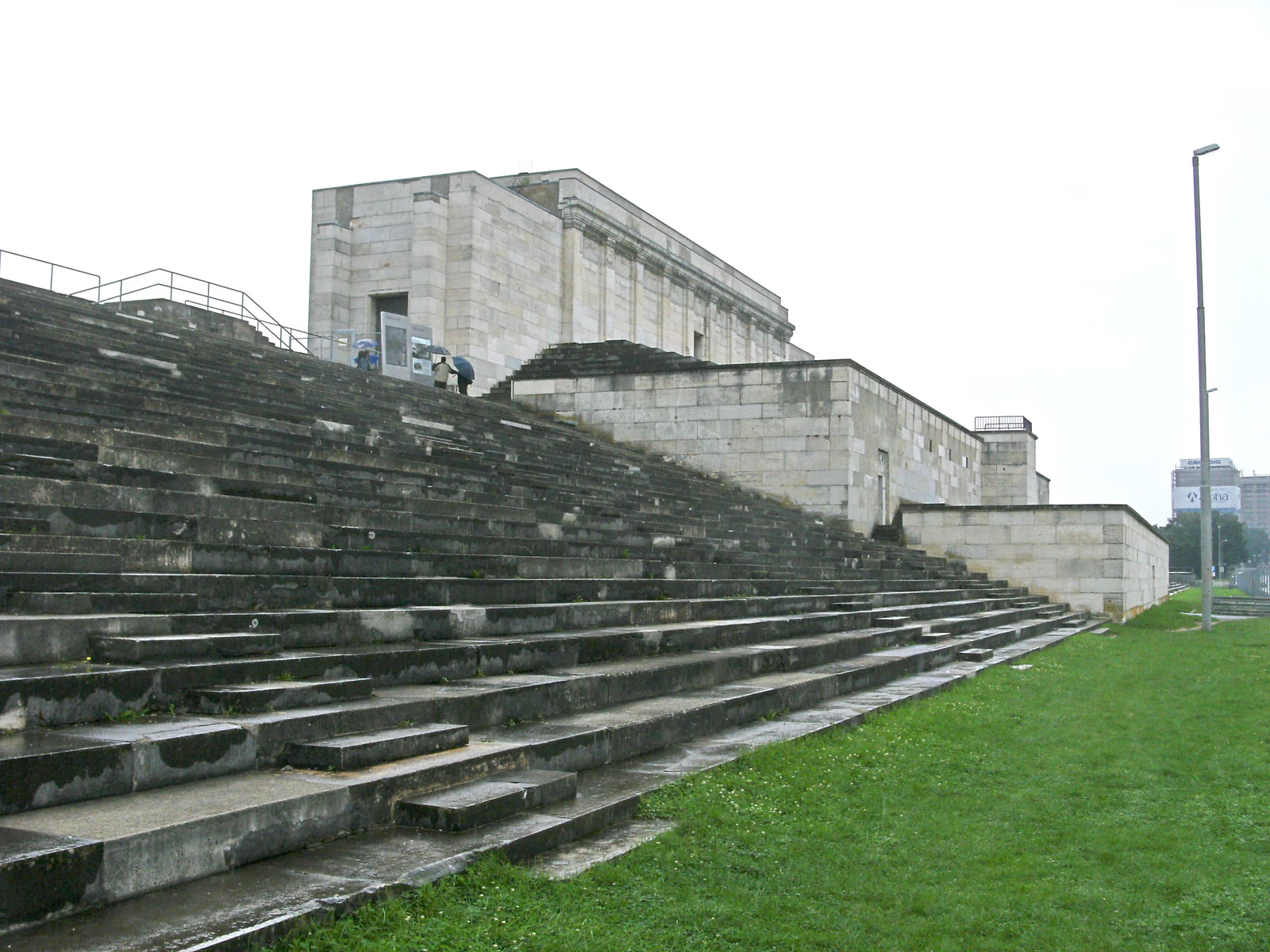
Hitler moved the party rallies onto the Zeppelinfeld in 1933 and in 1934 ordered Speer's temporary timber stands replaced in stone, overwriting what the site had been since 1926 — a municipal sports and recreation ground laid out to plans by the city garden director Alfred Hensel. Speer delivered in time for the 1935 rally: the earth banks were reshaped, concrete slabs driven in to carry seating, and the northern main tribune demolished and rebuilt in masonry. A further campaign in 1936 added thirty-four block-like stone-clad towers housing lavatories and transformers and extended the main tribune, whose shell stood by September 1936; the interior, apart from the Golden Hall, was largely finished by the last rally in 1938. The grandstand survived the war intact. Its swastika was blown up on 22 April 1945, the pillared colonnade in 1967 and the two end pylons in 1976. It was placed under monument protection in 1973.
The Zeppelin grandstand was built to stage the Nazi party rallies, and its architecture is the instrument. German Wikipedia records that the ground held 320,000 people, of whom only 70,000 were seated spectators: the remaining quarter of a million stood in formation on the field, facing a main tribune 360 metres long modelled on the Pergamon Altar and carrying the central speaker's rostrum. Around the field stood some 150 anti-aircraft searchlights aimed vertically, powered by a substation built for the purpose; English Wikipedia records that this cathedral of light was designed by Speer, was a main aesthetic feature of the rallies from 1934 to 1938 and was filmed for the 1937 propaganda film Festliches Nürnberg. Six party rallies were held here between 1933 and 1938; English Wikipedia states that they had no programmatic task and served as a self-portrayal of the National Socialist state. Speer joined the Nazi Party in 1931; as General Building Inspector for Berlin from 1937 he was responsible for the Central Department for Resettlement that evicted Jewish tenants from their homes in Berlin; in February 1942 he became Reich Minister of Armaments and War Production, and in 1944 established a task force that became instrumental in exploiting slave labour. At the Nuremberg trials he was found guilty of war crimes and crimes against humanity, principally for the use of slave labour, narrowly avoided a death sentence, served twenty years and was released in 1966. The Kongresshalle, Zeppelinfeld and Große Straße have been protected monuments since 1973 as significant examples of Nazi party architecture, and the whole site is now a memorial maintained to commemorate the victims of Nazi repression.
Wikidata Q49006263 · Commons: File:Stage Zeppelinfeld in Nürnberg.JPG · Photo: Mark Ahsmann · Licence: CC BY-SA 3.0