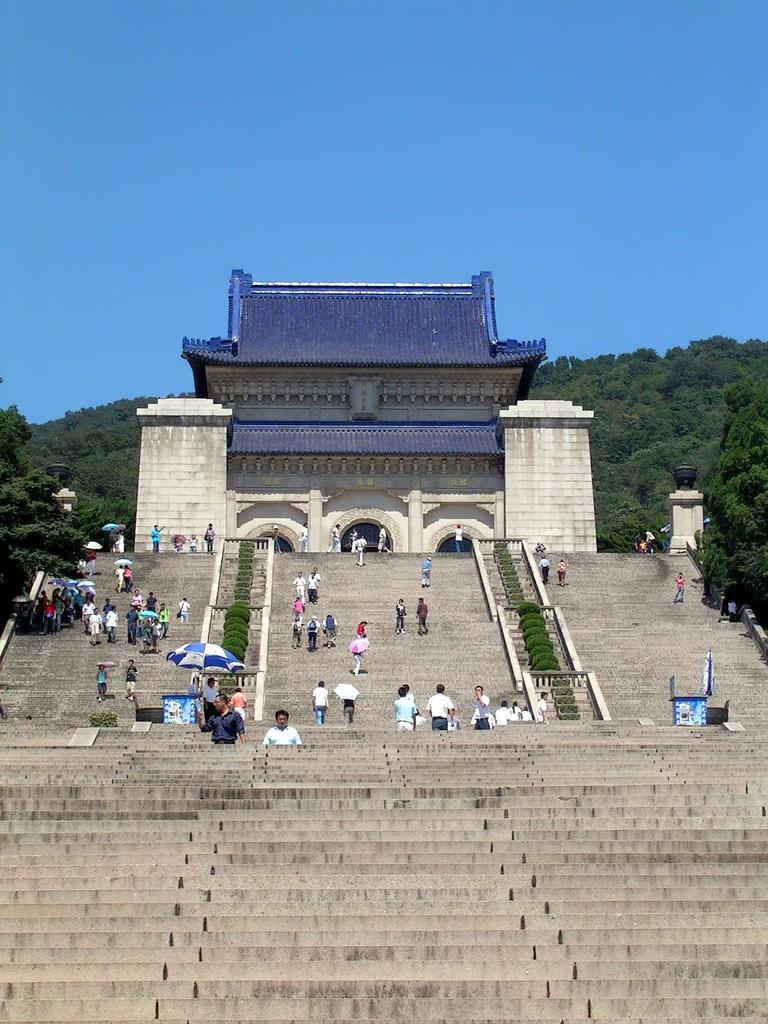
The competition brief of May 1925 was unusually explicit: the tomb was to be Chinese in spirit yet modern, memorial in substance, and buildable for 300,000 yuan. More than forty entries arrived; the committee chose Lü Yanzhi unanimously in September. What he delivered reads as one long ceremonial ascent rather than a building — a paifang, a gate, a stele pavilion, then a 392-step stair climbing between pines and ginkgos to a granite hall whose blue glazed roofs and white stone were taken to stand for the Nationalist flag. Beneath the palace roof profile are Western construction methods and a Beaux-Arts axial plan learned at Cornell and in Henry Murphy's office; the layout as a whole was drawn in the shape of an alarm bell, answering Sun's charge to awaken the people. Work began in January 1926, the hall and the main structures were finished in the spring of 1929 and the complex only in 1931; the final cost passed three million yuan. Lü died of cancer that March, months before Sun was interred. Liang Sicheng later argued the hall's proportions betrayed a borrowed rather than understood tradition.
The mausoleum was built as a national shrine of the ruling Kuomintang from the outset: a stele set by the party stands in the pavilion below the ceremonial stair, and the sacrificial hall's ceiling is painted with the KMT's Blue Sky with a White Sun flag. President Chiang Kai-shek opened and visited it in 1929, after the Nationalist government's Northern Expedition victory, and returned in the summer of 1946 after the war with Japan; on 29 March 1948 he led the delegates of the first National Assembly there to pay respects, and did so again with vice-president Li Zongren around his own inauguration as the Republic of China's first president that May. During the wartime Japanese occupation, troops were stationed to keep the collaborationist government of Wang Jingwei, installed in Nanjing in 1940, from encroaching on the site; a tomb built for Wang beside the mausoleum was demolished on Nationalist orders once Japan surrendered. Kuomintang chairmen have continued to travel from Taiwan to pay respects, from Lien Chan in 2005 to Cheng Li-wun in 2026.
Wikidata Q1338405 · Commons: File:Hall_of_Sun_Yat-sen_Mausoleum.jpg · Photo: Jiong Sheng · Licence: CC BY-SA 2.0