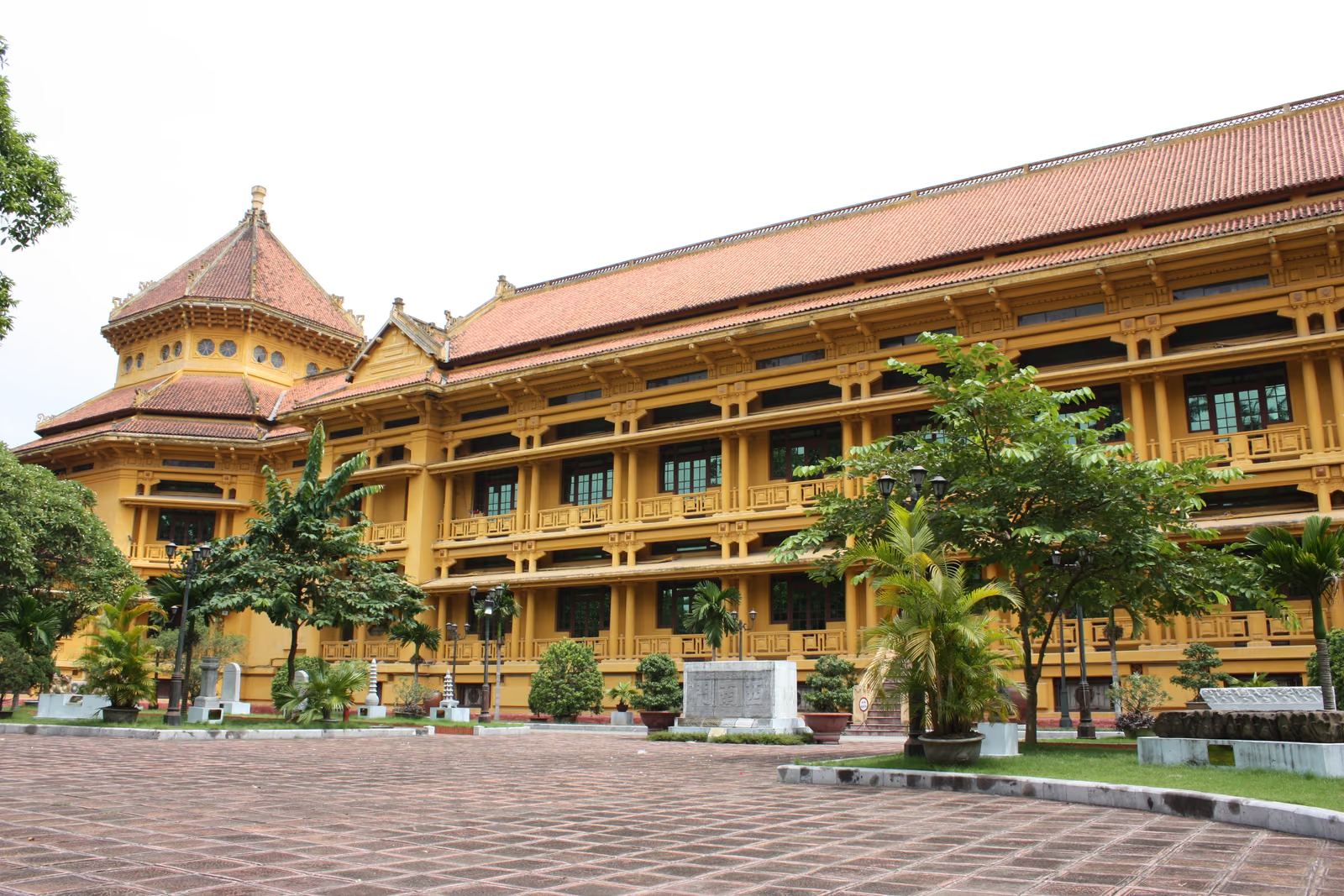
The museum behind the Hanoi Opera House opened in 1910 as a branch of the École française d’Extrême-Orient, was refurbished in 1920, and was then redesigned between 1925 and 1932 by Ernest Hébrard with Charles Batteur into the building that stands today. It is the clearest surviving statement of what Hébrard called the style indochinois: a reinforced-concrete frame, an octagonal cupola over the entrance rotunda, and multi-tiered tiled roofs, deep balconies and double walls borrowed from Vietnamese and Khmer models and put to work as passive ventilation and shading. As head of the Architecture and Town Planning Service of French Indochina, Hébrard was arguing through form that French rule could belong in Asia. The government of North Vietnam took the building over in 1958 and opened it to the public on 3 September that year; it now holds around 200,000 objects covering Vietnamese history to 1945.
The building was the Hanoi museum of the École française d’Extrême-Orient, the research institution through which France studied and catalogued the archaeology of its Indochinese possessions, and it was designed by the head of the colony’s own Architecture and Town Planning Service. The style indochinois Hébrard developed here and at Da Lat grafted Vietnamese and Khmer roof forms onto French institutional buildings; it was an instrument of colonial legitimation as much as an aesthetic position. The Democratic Republic of Vietnam took the building over in 1958 and reopened it as a national museum.
Wikidata Q5370414 · Commons: Vietnam National Museum of History, Hanoi, Vietnam.jpg · Photo: Alistair Morrenger · Licence: PD