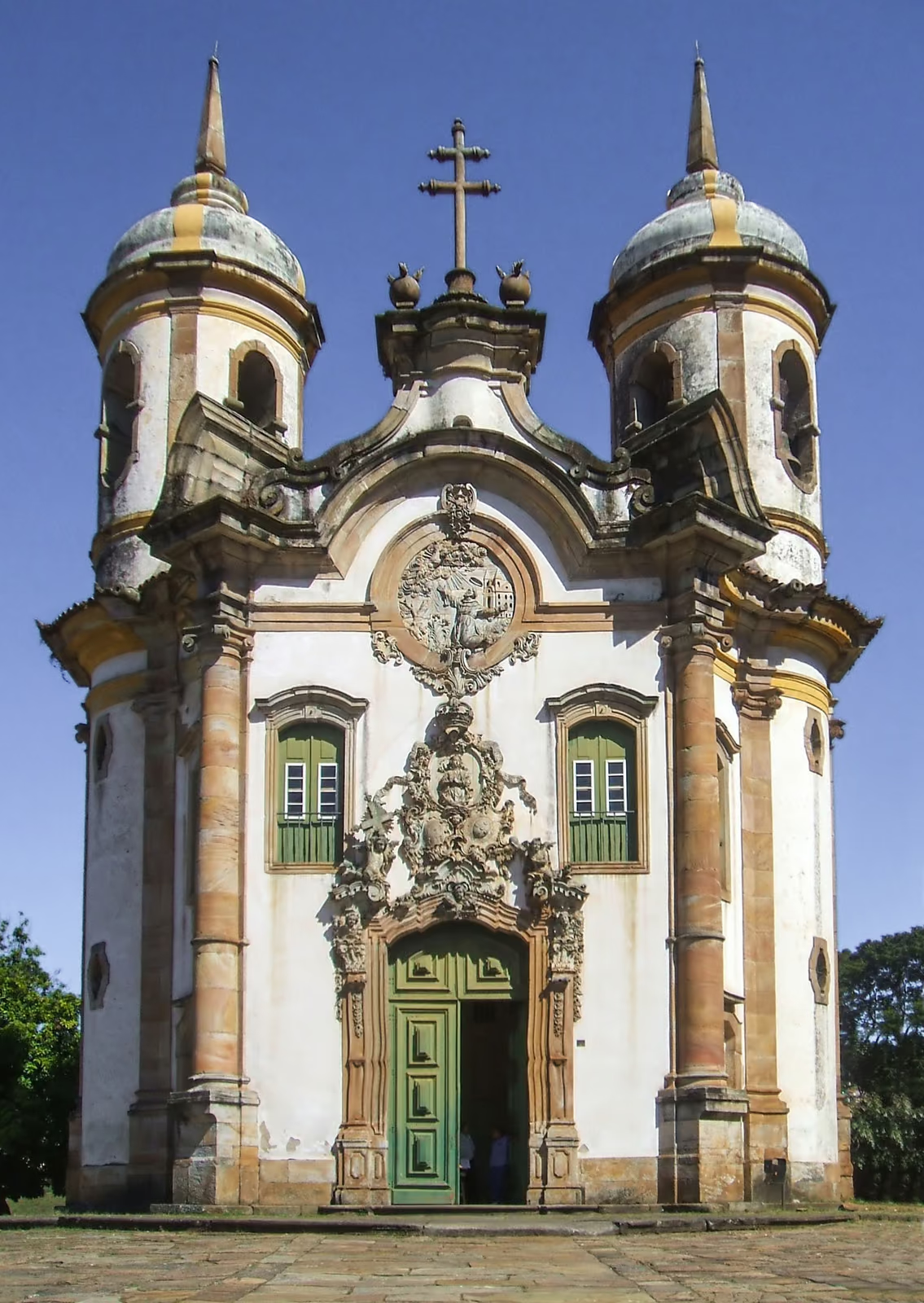
The Third Order of Saint Francis applied to Lisbon for permission to build in 1752 and waited nineteen years for an answer. Rather than wait, it began: the ground was prepared around 1765 and in 1766 the works were contracted to the master mason Domingos Moreira de Oliveira, following a design by Aleijadinho. Official authorisation arrived only in 1771. The chancel was roofed by 1774, the tower design revised in 1787, the roof laid in 1788 and the masonry finished in 1794. What Aleijadinho gave the building was a façade held in tension: the two bell towers are cylinders, unheard of in Brazilian church architecture at the time, and they are pulled back into the front so the whole elevation curves. Between them a soapstone frontispiece carries the stigmatisation of Saint Francis under an oculus, and the carved portal below it runs riot in a way the plain whitewashed walls never do. Portuguese Wikipedia calls it a masterpiece of Brazilian colonial art and one of the most celebrated creations of Aleijadinho.
Ouro Preto's wealth in the eighteenth century came from gold mining worked by enslaved Africans, and English Wikipedia records that much of that wealth was invested in building and decorating churches. The designer of this one was himself born into that system: Antônio Francisco Lisboa was the illegitimate son of the Portuguese architect Manuel Francisco Lisboa and an enslaved African woman. English Wikipedia states that his birth status kept him out of the circles of local artisans, and that "his mixed-race status and ability to claim a white father, along with his profession as an artisan, allowed Lisboa to distance himself from the slaves who built his churches without fully claiming whiteness." The masonry contract for this church was let to the master mason Domingos Moreira de Oliveira in 1766; the labour that executed it was that of a slave society.
Wikidata Q2337984 · Commons: SFrancisOuroPreto-CCBY.jpg · Photo: Sarah and Iain · Licence: CC BY 2.0