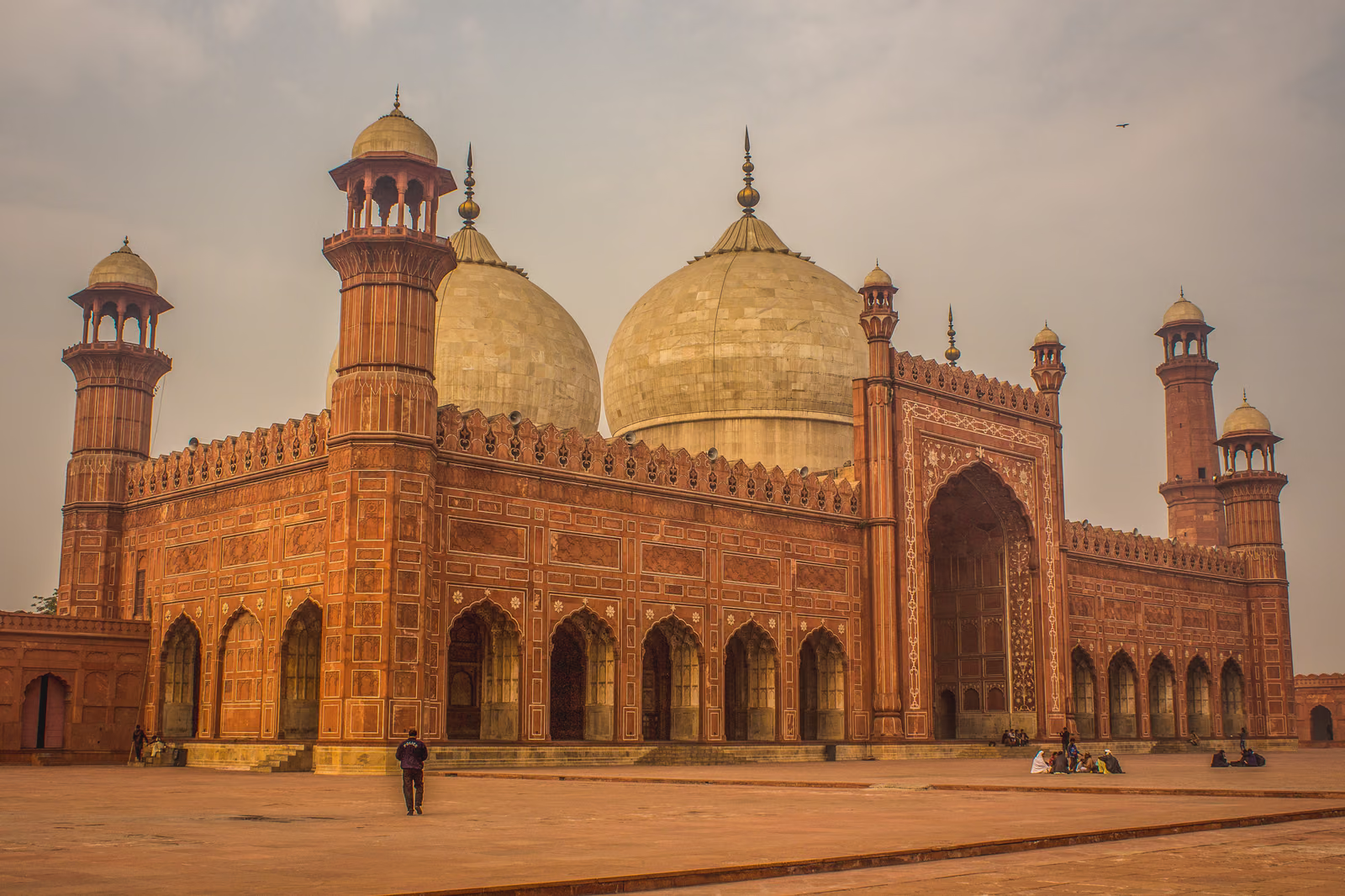
Ordered by Aurangzeb in 1671 and finished in 1673, the Badshahi is the last and the largest of the great Mughal mosques, and it was built fast — roughly two years for a courtyard that holds a hundred thousand people. The speed shows in the method rather than the finish: a brick carcass clad in Jaipur red sandstone, the carving concentrated where the eye lands, the three marble domes set out so that the central one reads as dominant from the fort opposite rather than from the courtyard. The plan is a straightforward answer to Shah Jahan’s Jama Masjid at Delhi, scaled up. Its later history is not straightforward at all, and is given in the context note below. The 1939–1960 restoration, directed by Nawab Zen Yar Jang Bahadur, replaced much of the sandstone facing and reinstated the courtyard surface.
The mosque ceased to function as a mosque for most of the nineteenth century. After the Sikh Empire took Lahore in 1799, Ranjit Singh used the courtyard as a stable for army horses and the hujras — the cells around the court — as quarters for his soldiers; the mosque was also used as a magazine, and in 1841 Sher Singh mounted zamburahs, light artillery, on its minarets to bombard the fort held by Chand Kaur. After the British annexation of the Punjab in 1849 the mosque was used as a garrison by the British Indian Army, which demolished eighty of the hujras and replaced them with an open arcade to prevent them being used for rebellion. Amid Muslim resentment, the British handed the mosque back to the Muslim community through the Badshahi Mosque Authority in 1852, and repairs were carried out piecemeal from then on. A full restoration ran from 1939 to 1960 at a cost of about 4.8 million rupees.
Wikidata Q330872 · Commons: Badshahi Masjid - Side View.jpg · Photo: Jalal.shahid · Licence: CC BY-SA 4.0