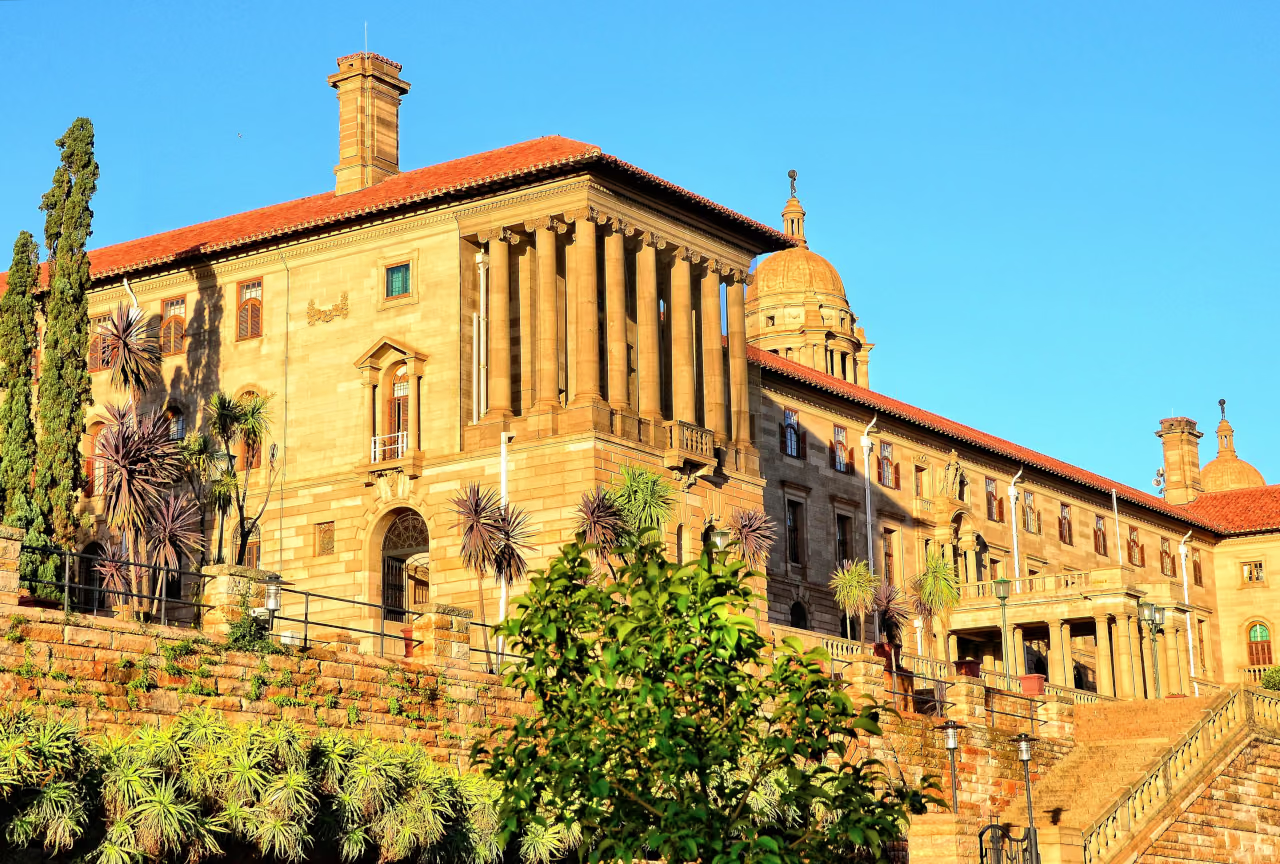
Herbert Baker set two long office wings on Meintjieskop, curved so that they read from below as a single amphitheatre wrapped around terraced gardens, and joined them with a semicircular colonnade beneath two domed towers meant, in his own description, to speak of the union of a formerly divided people: one wing for English speakers, one for Afrikaans. The cornerstone was laid on 1 November 1910, five months after the Union of South Africa joined the Boer republics to the Cape and Natal colonies; some 1,265 workers raised it in under three years using local sandstone, granite and indigenous timber over a steel-and-concrete frame, finishing in 1913 what was, at 285 metres end to end, the largest building the Southern Hemisphere had yet seen. It has housed the country's executive ever since, an unbroken span across the whole of segregation and apartheid and the government that succeeded them, and in 2024 it was inscribed on the World Heritage list as part of a set of sites recording Nelson Mandela's legacy.
The Union of South Africa that the Union Buildings were built to govern excluded its Black, Coloured and Indian majority from the franchise across most of the country from its founding in 1910, a foreclosure that hardened into apartheid after 1948; the government housed in this building administered both. On 9 August 1956 some 20,000 women marched on the Union Buildings to petition against the extension of pass laws to Black women, a date now marked annually as National Women's Day. On 10 May 1994 Nelson Mandela was inaugurated as South Africa's first president elected by universal suffrage on the building's terraces, and the amphitheatre was renamed for him in 2013, the year of his death, alongside a nine-metre bronze statue of him unveiled there.
Wikidata Q2264091 · Commons: File:Union Buildings in Pretoria, ZA.JPG · Photo: Ossewa · Licence: CC BY-SA 4.0