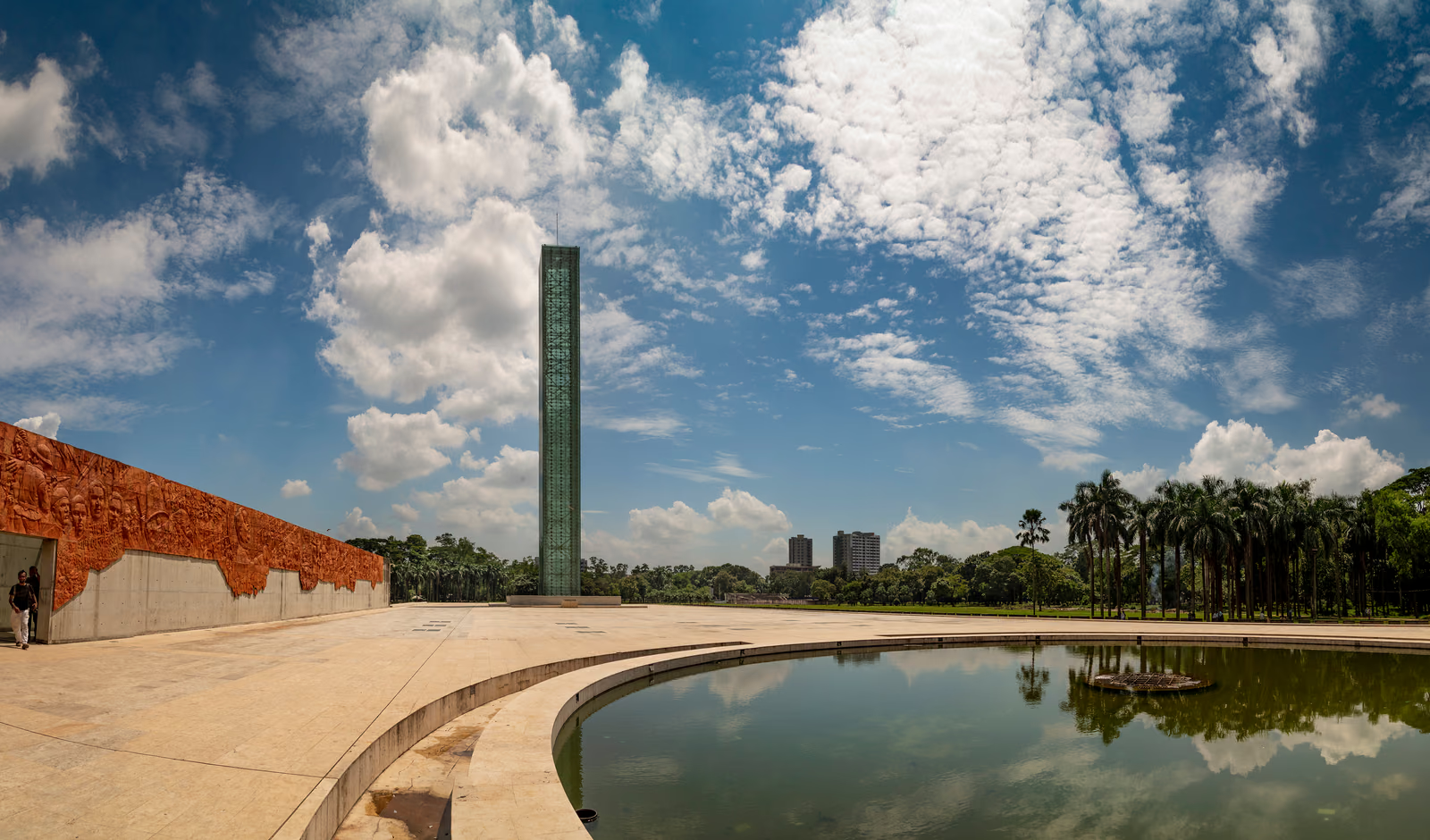
Marina Tabassum and Kashef Mahboob Chowdhury won the competition for this in 1997, two years out of BUET, and carried it for sixteen years. Their answer to a national monument was to build almost nothing above ground. The museum, the projection theatre and most of the programme are buried; what stands on the plaza is a single fifty-metre shaft made of stacked sheets of glass — a Tower of Light, placed on the spot where the Pakistani Instrument of Surrender was signed on 16 December 1971. Glass was chosen because it is not stone: the tower changes with the weather, disappears at certain angles and glows from within at night, refusing the permanence that a monument of this kind is normally asked to assert. Around it are a marble plinth, a long terracotta relief wall, an eternal flame, an amphitheatre and a water body. Construction began in 1999 and the complex was completed in 2013.
The site is the Suhrawardy Udyan, formerly the Ramna Race Course, where Sheikh Mujibur Rahman delivered his 7 March 1971 speech and where the commander of the Pakistan Army in East Pakistan, A. A. K. Niazi, surrendered to the joint Bangladeshi and Indian command on 16 December 1971. The war that the monument commemorates began with the Pakistan Army crackdown of 25 March 1971 and lasted nine months. Its death toll is disputed between the parties: the Government of Bangladesh states that three million people were killed, a figure repeated in Bangladeshi official accounts since 1972; the Pakistani Hamoodur Rahman Commission report, ordered by the Government of Pakistan and published in redacted form, gives a figure of roughly 26,000 civilian dead; independent scholarly estimates fall between these, with several placing the total in the hundreds of thousands. This pool records the dispute rather than adopting a figure. The Government of Bangladesh decided to build the monument in 1996 and held the competition in 1997.
Wikidata Q25587621 · Commons: Independence Monument glass tower.jpg · Photo: Masumcity · Licence: CC BY-SA 4.0