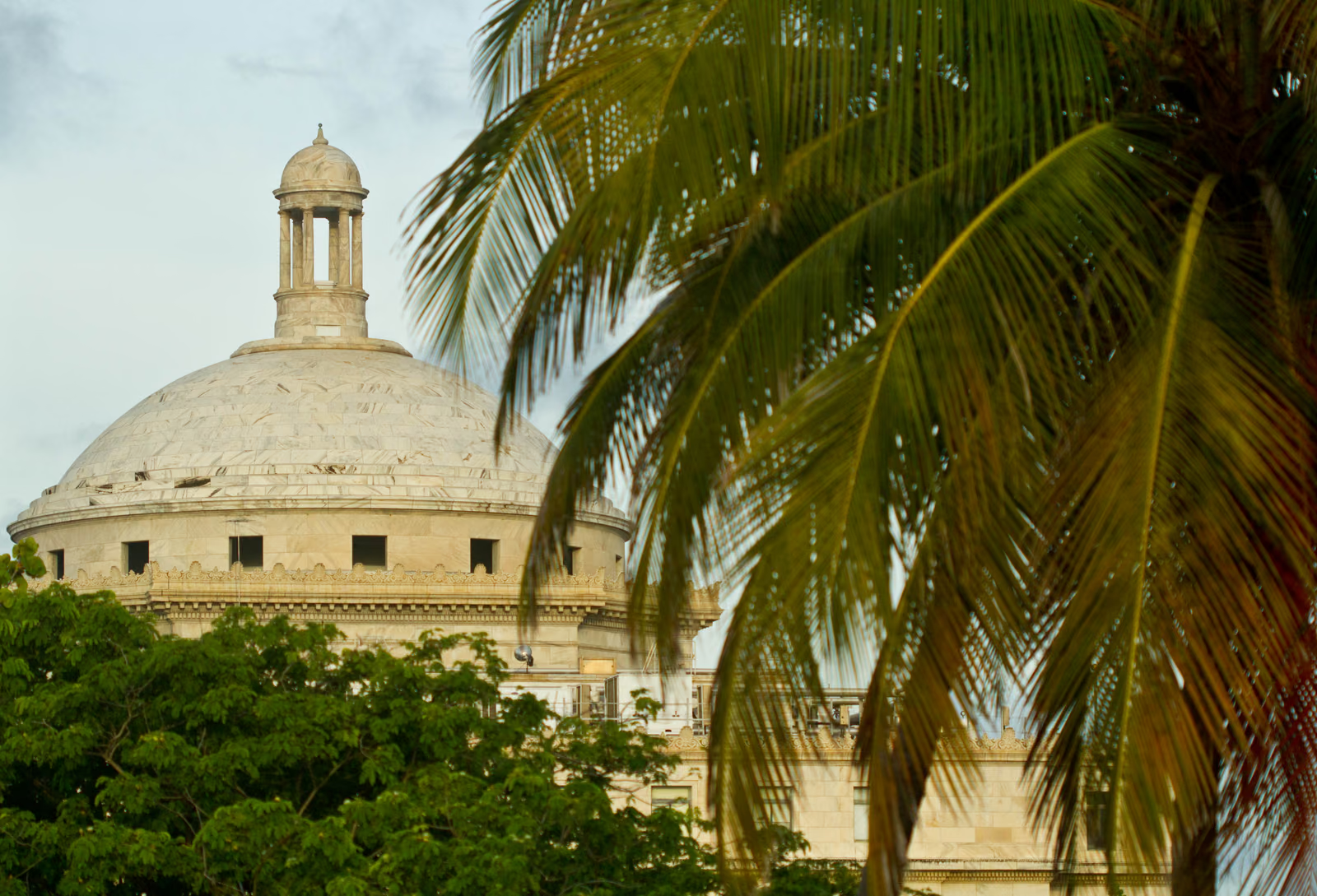
An international competition of 1907 gave the commission to the New York architect Frank Perkins, whose scheme, revised with Adrian Finlayson, proved troubled and slow; when Rafael Carmoega became Puerto Rico's first native State Architect in 1921, he inherited a half-built Capitol and set about finishing it as a neoclassical statement in white marble shipped from Georgia. The building was inaugurated on 11 February 1929, its double-shelled dome raised on an octagonal base of pendentives — a construction device borrowed from Hagia Sophia to carry a silhouette modelled on the Pantheon — though the dome's lantern and much of the interior ornament were not finished until 1961. Twenty-one varieties of marble, from Italy, the mainland United States and Spain, line an interior whose murals and mosaics by Rafael Ríos Rey, José Oliver, Jorge Rechani and Rafael Tufiño narrate Puerto Rican history under an American territorial administration that was, at the same moment, writing its own institutions into the island's stone. Listed on the National Register of Historic Places in 1977, the Capitol remains the working seat of the Senate and House of Representatives.
Puerto Rico has been an unincorporated territory of the United States since 1898, a status the Supreme Court's Insular Cases (1901–1905) held meant the Constitution applied only in part. The Capitol was commissioned in 1921 and completed in 1929 under the Foraker Act's insular government of elected Puerto Rican delegates and appointed American officials — Rafael Carmoega's first years as State Architect. Puerto Ricans had held US citizenship since the Jones–Shafroth Act of 1917, but neither then nor since have the island's residents held a vote in US presidential elections or voting representation in Congress; Puerto Rico sends one non-voting Resident Commissioner to the House of Representatives. That status — unincorporated territory rather than state — has remained unchanged through Puerto Rico's 1952 constitution and to the present day.
Wikidata Q4212987 · Commons: El Capitolio de Puerto Rico.jpg · Photo: Nheitjan · Licence: CC BY-SA 3.0