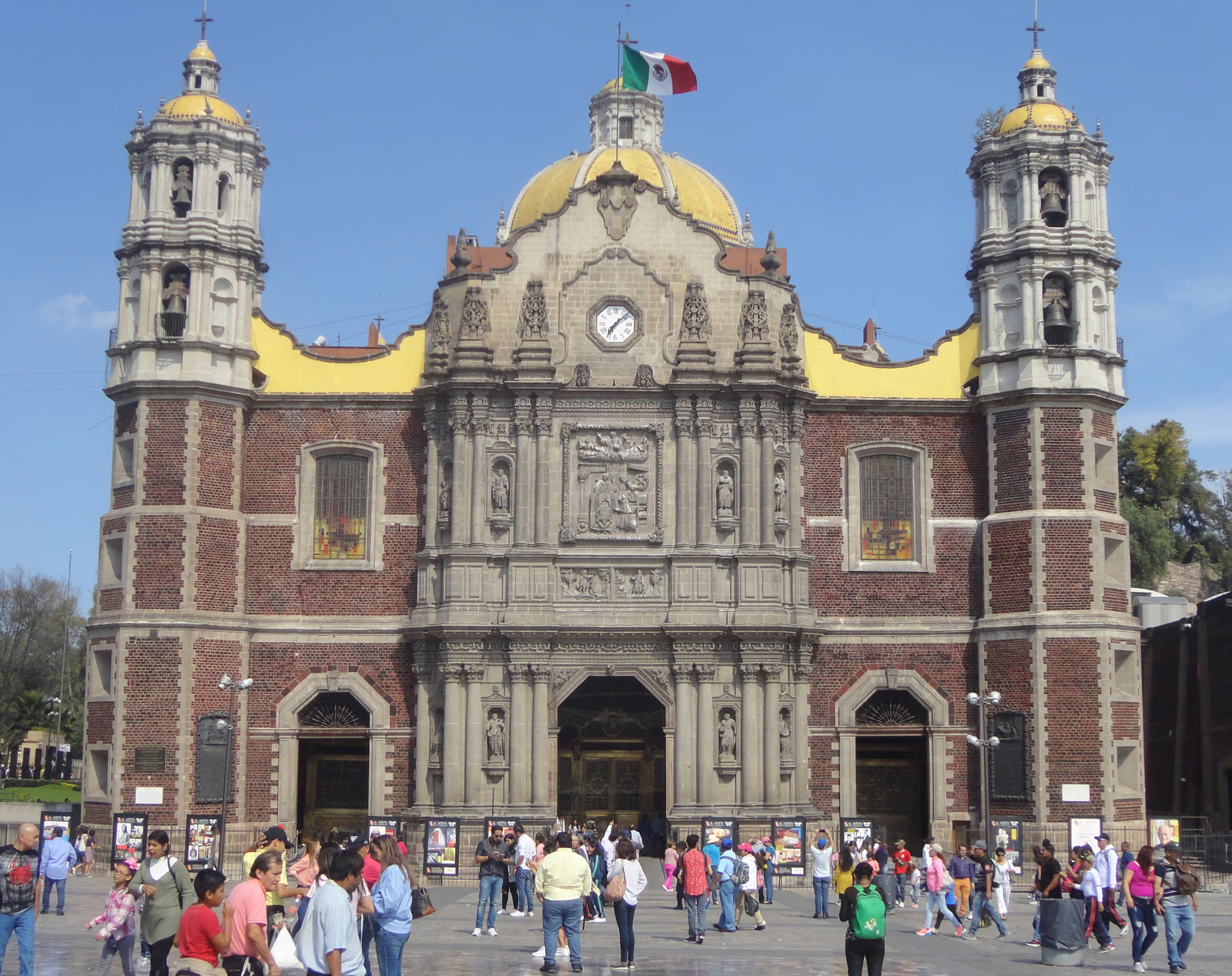
Work began in March 1695 and the church opened on 1 May 1709, which makes it the largest thing Pedro de Arrieta ever built and the clearest statement of his transitional manner. The front is not a facade in the usual sense but a screen, set forward of the body of the church like a folding panel, its grey chiluca relief held against walls of dark red tezontle. Four octagonal towers stand at the corners, and they and the dome are finished in yellow Talavera tile with a blue border, a scheme read at the time as the golden Jerusalem of Revelation. Almost nothing of the baroque interior survives: a neoclassical redecoration designed by Agustín Paz and carried out by Manuel Tolsá ran from 1804 to 1836, interrupted by the war of independence, and further campaigns followed in the 1890s and around 1929.
The sanctuary stands on and beside the hill of Tepeyac, which Spanish and Indigenous chroniclers agree was a place of worship before the conquest. Bernardino de Sahagún, Juan de Torquemada and the later chronicler Jacinto de la Serna all record that Nahua people continued to call the festival there one for "our mother", tonantzin or totlaçonantzin; the Códice Teotenantzin describes two images carved into the rock of the hill, one associated with Tonantzin and one with Toci, and a sculpture of Cihuacóatl was recorded by Guillermo Dupaix as found on the Tepeyac. Sahagún treated the continuity as a problem rather than a coincidence. The colonial shrine was therefore not built on empty ground: it replaced an existing cult on its own site, and Arrieta's church is the third and most monumental of the buildings raised there under Spanish rule.
Wikidata Q67772495 · Commons: File:Templo Expiatorio a Cristo Rey (Antigua Basílica de Guadalupe) - Frente.jpg · Photo: Juan Carlos Fonseca Mata · Licence: CC BY-SA 4.0