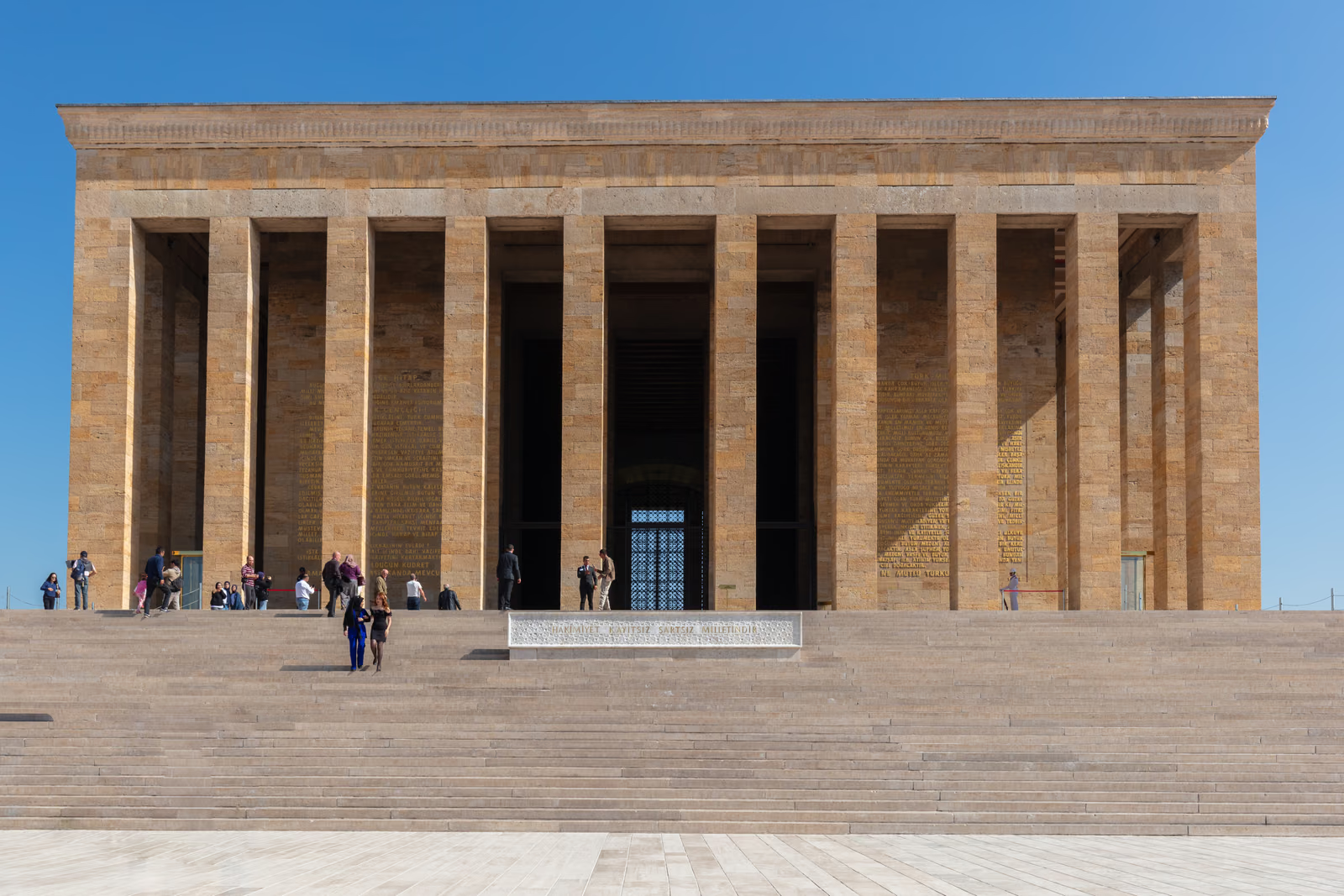
Turkey announced an international competition for Atatürk’s tomb on 1 March 1941 and received forty-nine entries. Emin Onat and Orhan Arda, both teaching at Istanbul Technical University, won it, and construction opened with a ceremony on 9 October 1944. The work ran in four stages over nine years — foundations, then the mausoleum itself, then the approach roads and interiors, then finishing — and ended on 1 September 1953. Atatürk’s remains were moved there on 10 November 1953, fifteen years to the day after his death. A visitor arrives along a 262-metre avenue lined with twenty-four stone lions, crosses a plaza sized for fifteen thousand people and climbs to a colonnaded hall 41.65 by 57.35 metres and 17 metres high. Beneath the travertine from Kayseri, Polatlı and Malıköy and the marble from Hatay, Adana, Afyonkarahisar and Bilecik, the structure is reinforced concrete. The stripped symmetrical monumentality is the Second National Architectural Movement at full stretch.
Anıtkabir was commissioned by a one-party state. The site on Rasattepe in Ankara was fixed on 17 January 1939 at a meeting of the parliamentary group of the Republican People’s Party, then the only legal party in Turkey, and the land was expropriated; responsibility for every service and task on the site still belongs to the General Staff of the Turkish Armed Forces, events held there are regulated by law, and official ceremonies take place on national holidays, on the anniversary of Atatürk’s death and during the state visits of foreign governments. The competition for Atatürk’s mausoleum was judged in the middle of the Second World War. On 21 March 1942 the commission shortlisted three of the forty-nine entries: those of the Italian Arnaldo Foschini, the German Johannes Krüger, and the Turkish pair Emin Onat and Orhan Arda. Foschini was a professor at Rome and worked extensively for the Fascist state building programme, including the University City of 1932–35 and the church of Santi Pietro e Paolo at EUR of 1937–41. Krüger, with his brother Walter, had built the Tannenberg Memorial, completed in 1927; after Hindenburg’s death in 1934 Hitler ordered the monument redesigned and renamed the Reichsehrenmal Tannenberg, and the Krüger office was called back to carry out that work. The Turkish government announced its choice of Onat and Arda on 9 June 1942, and theirs is the design that was built.
Wikidata Q615404 · Commons: Anıtkabir, Ankara, Turquía, 2024-10-03, DD 02.jpg · Photo: Diego Delso · Licence: CC BY-SA 4.0