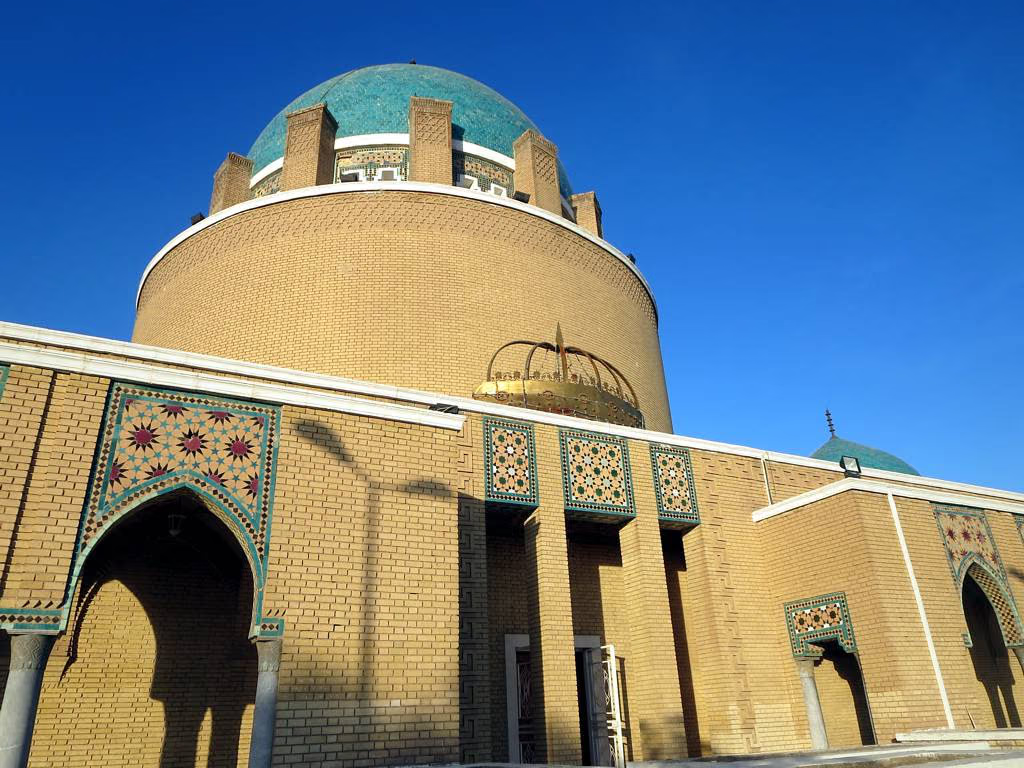
Faisal I died in 1933, eleven years into a kingdom the British had built for him, and the mausoleum raised in Adhamiyah between 1934 and 1936 had to say what that kingdom was. J. Brian Cooper, the Englishman serving as the Hashemite state's official architect, gave it three tiled domes over a central hall, walls of beach stone faced in brick and teak joinery, and a scale that Elizabeth Bishop reads as borrowed from Britain's royal burial ground at Frogmore, consecrated only a few years earlier. Onto that frame he grafted Abbasid, Ottoman and pan-Arab motifs. The result is not a hybrid by accident: a post-Ottoman monarchy under British mandate needed a building that could claim descent from the caliphs and parity with European royalty at once, and Cooper built exactly that.
The mausoleum is a monument of the Iraqi monarchy installed under the British Mandate, designed by a British architect employed by that monarchy, and its architectural sources were chosen accordingly. Elizabeth Bishop's 2022 study reads the central dome and the overall scale as drawn from the British Royal Burial Ground at Frogmore, set deliberately alongside Abbasid, Ottoman and Egyptian references — a design argument about where the new state placed itself. The monarchy was overthrown in the revolution of 1958 and the last king, Faisal II, was killed; he is buried here. The site was restored and reopened to the public on 27 March 2021.
Wikidata Q16128350 · Commons: File:Royal mausoleum in baghdad.jpg · Photo: David Stanley · Licence: CC BY 2.0